
Legends & Cycles — Under the Megalith
“Civilizations pass. Structures remain. A structural reading of worlds, systems and cycles.”
Markets Do Not Grow — How Global Markets Actually Work
Markets do not grow. They organize.
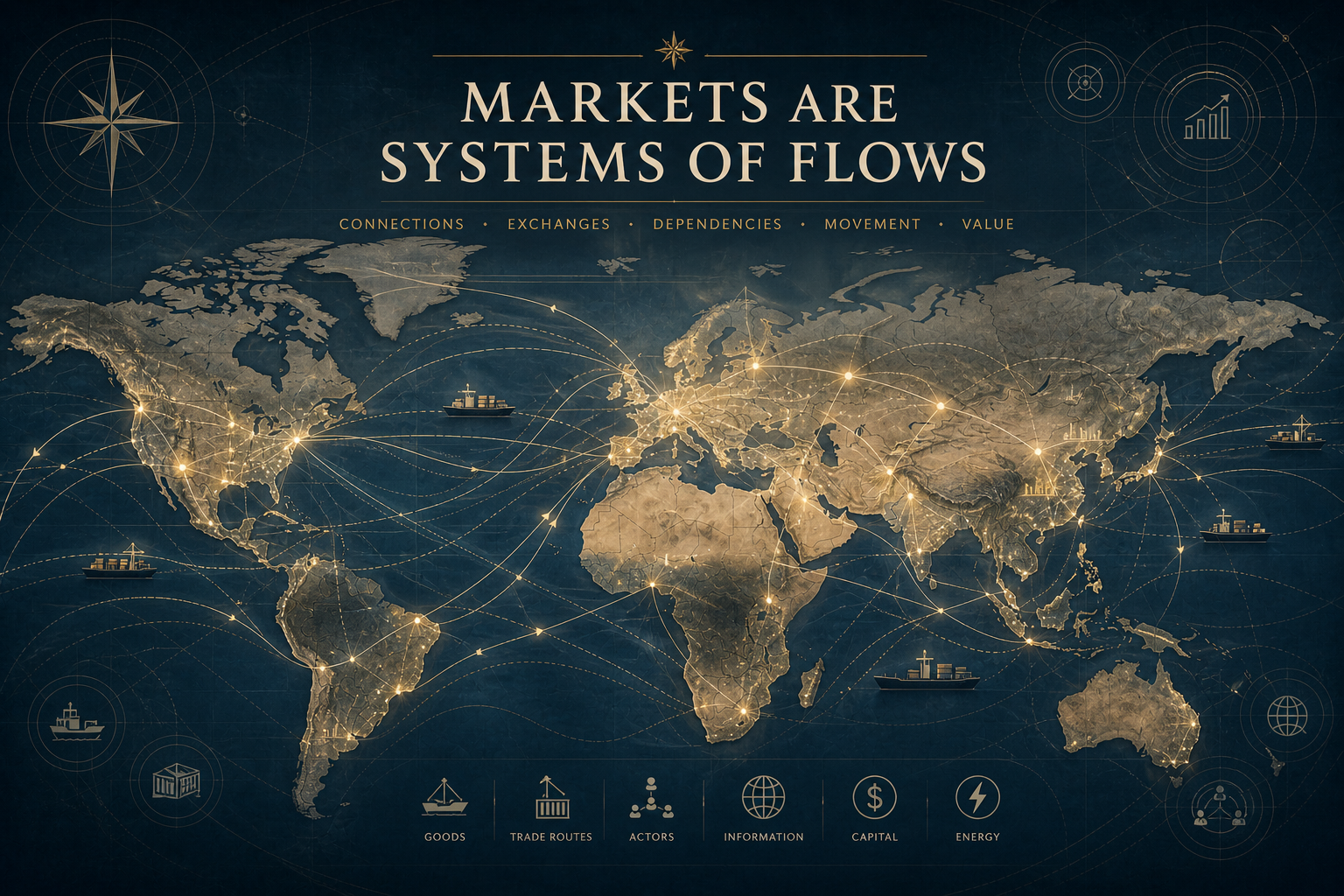
Markets are usually described through growth. Growth is visible. Growth can be measured. Growth dominates headlines. But growth is not structure.
From growth to systems. A market does not exist because demand increases. It exists because a system holds. Three conditions are required: flows, interfaces, constraints.
Flows move goods, energy, and information. Interfaces connect regions, actors, and layers. Constraints shape what can actually function. Remove one of these, and the market dissolves. 👉 A market is a system of circulation under constraint.
What conventional analysis misses. Most economic analysis focuses on: GDP, expansion, consumption. These describe movement. They do not describe organization. A growing market can still be structurally weak. A constrained system can remain highly stable. 👉 Movement is not structure.
What actually organizes markets
Markets are not built from demand alone. They are structured by deeper layers:
• energy systems
• logistics networks
• industrial capacities
• infrastructure
Energy enables production. Logistics enables circulation. Industry enables transformation. Infrastructure enables continuity. Before a market expands, a system must already exist. 👉 Systems organize flows before markets appear.
The role of constraint. Constraint is often seen as a limitation. But in reality, it is a structuring force. Geography limits movement. Energy limits production. Demographics shape demand. Politics defines boundaries. These constraints do not only restrict. They organize. 👉 Constraint creates organization.
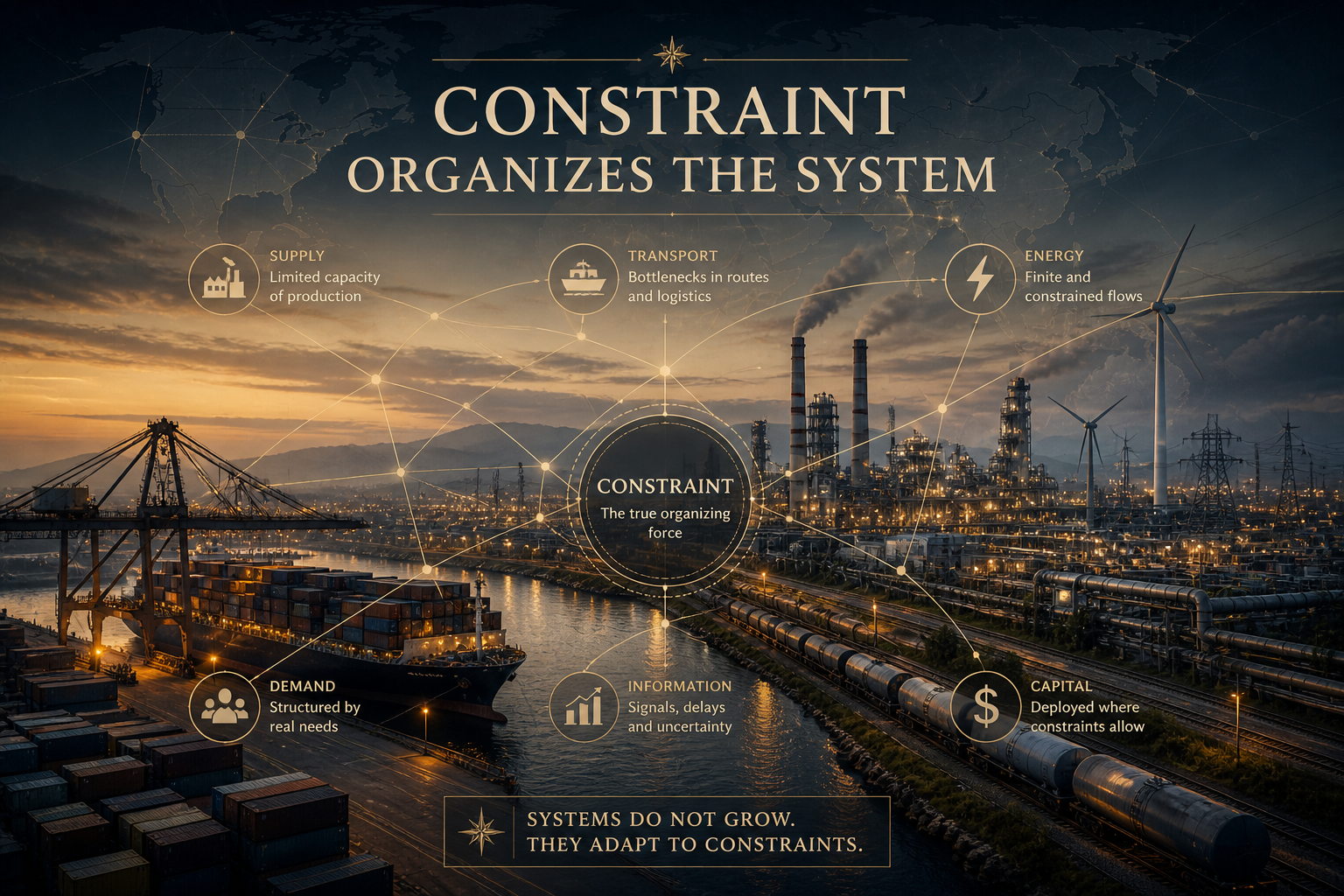
Different functions, not equal growth
Not all regions play the same role. Some concentrate production. Some connect systems. Some stabilize under pressure. A region is not defined by its size. It is defined by its function. 👉 Not all regions grow. All regions function.
A system in transition. The current phase is often described as a crisis. But what we observe is different. Supply chains are reorganizing. Energy systems are shifting. Geopolitical structures are fragmenting. This is not collapse. It is reconfiguration. 👉 The system is reorganizing, not collapsing.
What Market Cycles does. The Market Cycles series reads global regions as systems:
• identifying flows
• mapping constraints
• understanding functions
• observing long-term cycles
Not as growth stories — but as structured realities.
Explore the Market Cycles collection
Each volume examines a region as a system:
Existing volumes
• South China — the industrial core of global integration
• Oceanic India — infrastructure, scale and systemic expansion
• US Sunbelt — the operational engine of the Western system
• North Africa — a system of defensive viability under constraint
• Southeast Asia — a maritime interface organizing global flows
Upcoming
• Adriatic–Danube Europe — a corridor structuring European continuity
• Arctic Governance — thresholds, routes and emerging strategic layers
👉 Explore the Market cycles collection / Full analyses / See all collections: https://legendsandcycles.com
Closing. Markets do not grow. They organize.
conversion: https://www.legendsandcycles.com
🎯 Linkedin:
Markets do not grow. They organize.
Growth is visible. Structure is not. This article introduces the framework behind Market Cycles.
👉 Read here: Markets Do Not Grow — How Global Markets Actually Work | Legends & Cycles — Under the Megalith
About Jean-Marc BELOT

 Legends & Cycles — Under the Megalith