
Legends & Cycles — Under the Megalith
“Civilizations pass. Structures remain. A structural reading of worlds, systems and cycles.”
Symbolic Landscapes — A Structural Reading of Sacred Spatial Systems
Landscapes are not places. They are structured systems.
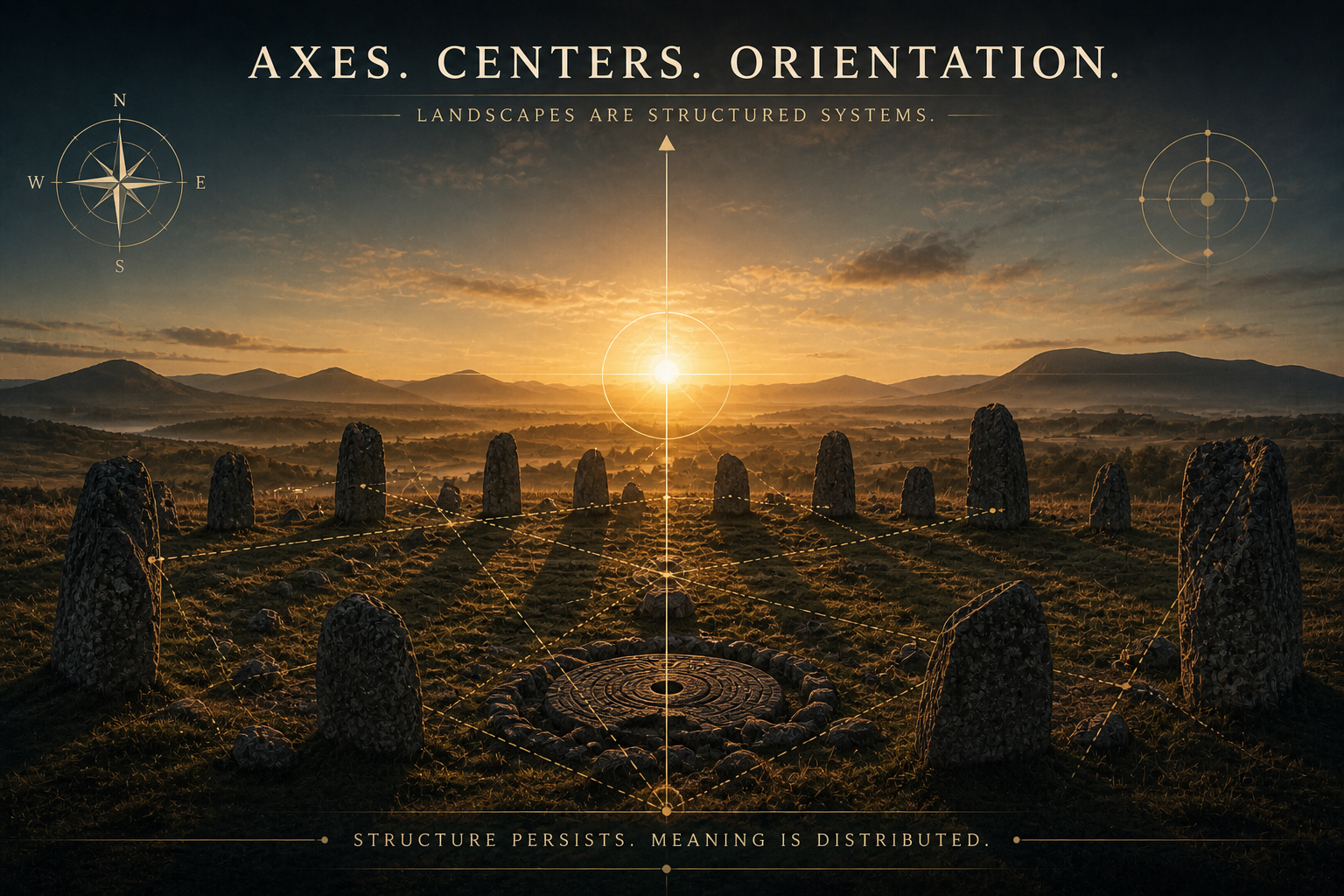
Sacred sites are often described as isolated phenomena. A stone circle here. A sanctuary there. A myth attached to a location. But this perspective fragments what is, in reality, organized.
Beyond isolated sites
Across regions and periods, the same patterns appear: alignment, orientation, elevation, repetition. These are not symbolic decorations. They are spatial structures.
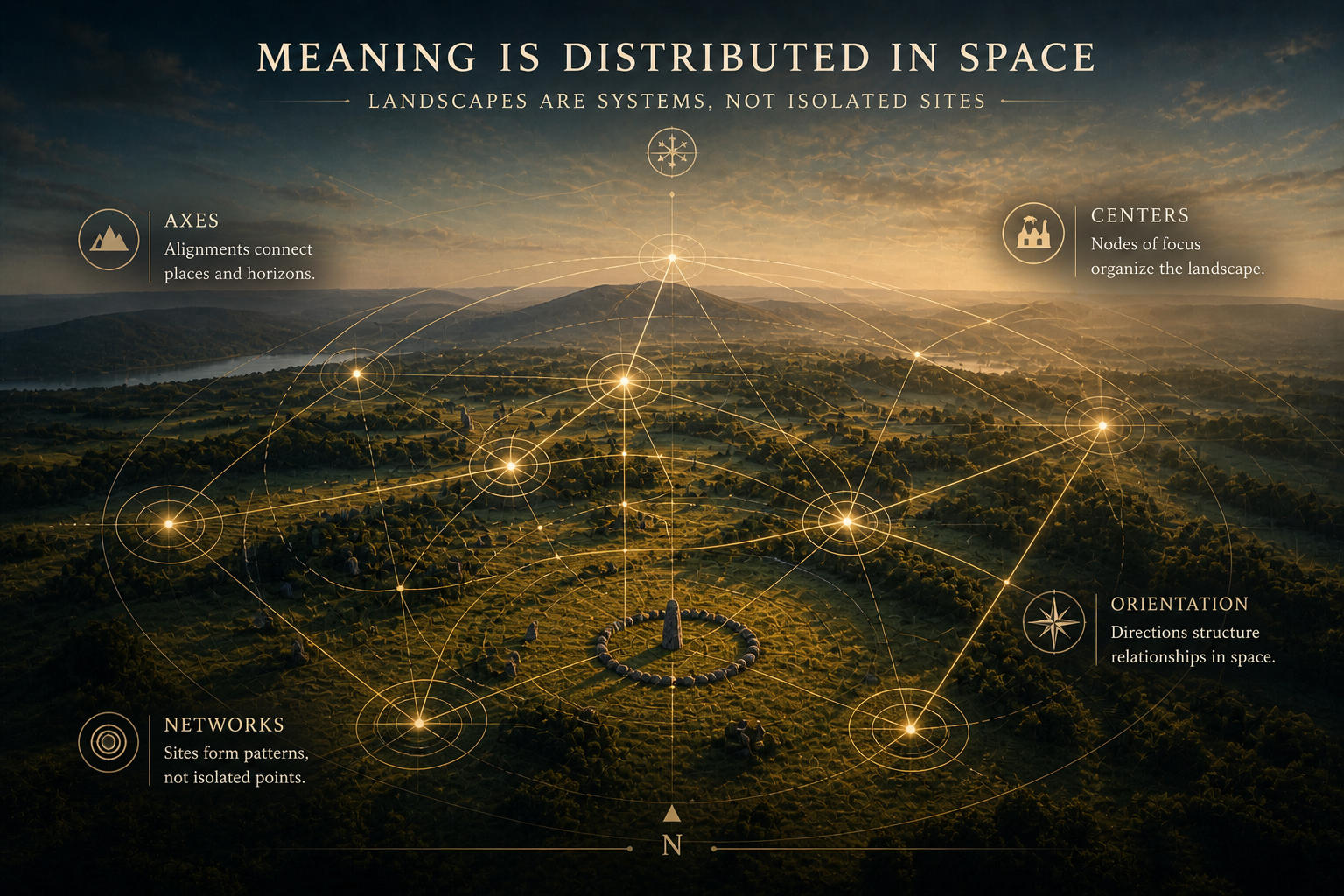
Landscapes as systems. A symbolic landscape is not defined by a single site. It is defined by relationships between centers, along axes, and across territories.
Meaning is not located. It is distributed.
What remains
Civilizations change. Narratives evolve. But structures persist.
Axes remain.
Centers remain.
Orientations remain.
From landscapes to structure. Once these patterns are recognized, a different reading becomes possible. Sacred geography is not a collection of beliefs. It is a system of organization in space.
What Symbolic Landscapes does. The Symbolic Landscapes series reads megalithic systems, sacred spatial networks, axes and orientations, and territorial structures. Not as myths alone — but as coherent spatial systems.
A different perspective. Landscapes are not passive. They are structured.
Explore the Symbolic Landscapes collection
Each volume reads a region as a spatial system:
• Mesopotamian Core Sites — centers, axes and early structured territories
• Anatolia–Caucasus — highland systems and transitional spatial forms
• Pacific Systems — oceanic landscapes and distributed structures
In development
• Additional regions extending the same structural reading
👉 Full volumes available at: https://www.legendsandcycles.com
About Jean-Marc BELOT

 Legends & Cycles — Under the Megalith