Legends & Cycles — Under the Megalith
“Civilizations pass. Structures remain. A structural reading of worlds, systems and cycles.”
What Megaliths Really Do — Reading Landscapes as Systems
Megaliths are not monuments. They are positions in a system.
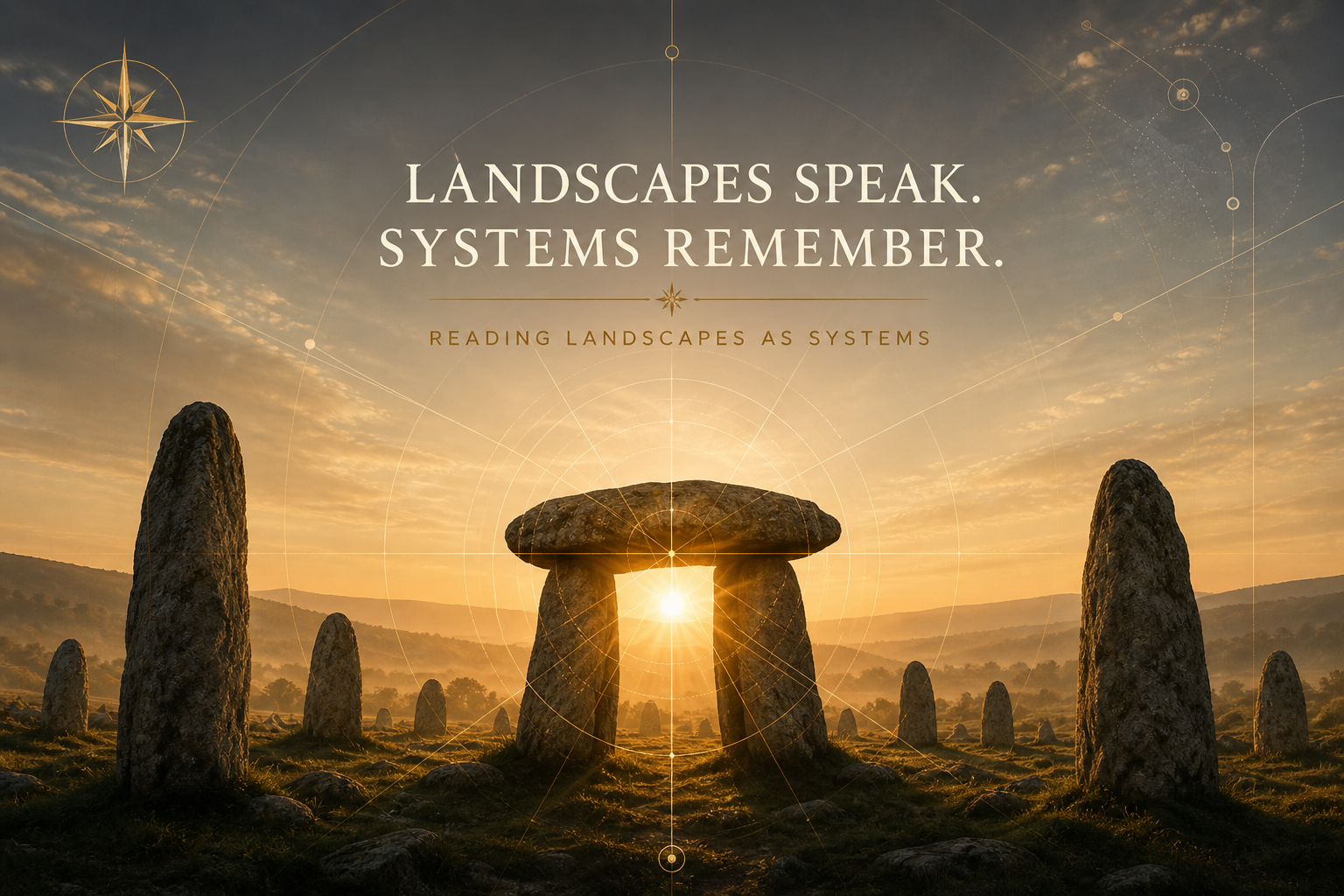
Megaliths are usually seen as isolated objects. A stone circle. A standing stone. A mysterious site in the landscape. They are often described as symbolic, ritual, or cultural. But this perspective fragments what is, in reality, organized.
From objects to structure. A megalith is not defined by what it is. It is defined by where it is. Not the stone — but its position. Not the object — but its relation to others. In this perspective, a site is not an isolated point. It is part of a structured spatial system.
Recurring patterns. Across regions and periods, the same patterns appear:
• alignments between stones
• orientations toward the horizon
• elevated positions
• repeated spatial configurations
These patterns are not accidental. They repeat because structure is intentional.
👉 Related reading:
La colline du Minotaure découverte en construisant un aéroport en Crète
La Poutre des Dieux: mont Faudé (Lapoutroie, Haut-Rhin)
Chine: la Mer des Cinq-Fleurs, miroir de la déesse
Les Douze Apôtres venus prendre l’eau de la côte sud de l’Australie
Châteaux de la Fata Morgana, au Finistère (île de Batz, île de Sein) et à Marseille
Le château de Robert le Diable
Cap Leucade: le Saut vers l’Au-Delà
Ile Maurice. Chamarel : Terre aux Sept Couleurs, Grande Cascade, Madame Bell, esprits errants, cloches, Nyahbingi, Tilambik, Sega, Shiva
Oncieu, le diamant du Bugey
Yamagata : monstres de neige du mont Zao
Ponta Delgada (Açores): Boca do Inferno et les Sept Cités englouties
Le Mont Royal, toit de la Thaïlande: Doi Luang / Doi Inthanon
Les disparus du mont Otorten (en Mansi: n’allez pas là)
Tombeau du Géant, à Botassart (Belgique)
Hoodoo Rock: cheminée de fée américaine
What is actually organized
What megalithic systems organize is not objects. They organize space.
• axes connecting points
• centers structuring perception
• limits defining zones
• visibility across distance
The horizon matters. Direction matters. Distance matters. Space is organized before it is interpreted.
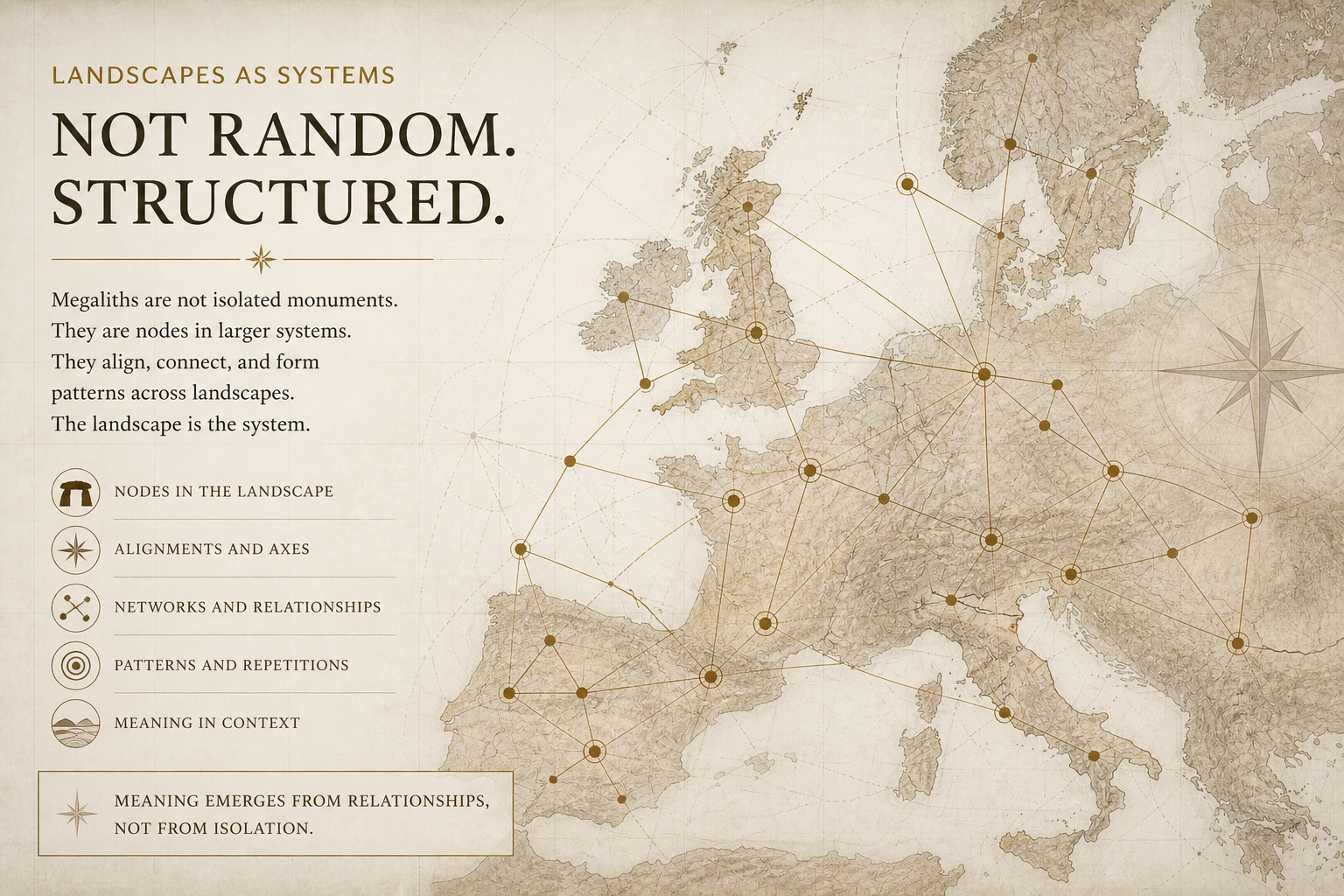
Landscapes as systems. A landscape is not a collection of sites. It is a network. Sites relate to one another. Axes connect them. Meaning emerges from the whole. It is not located in one place. It is distributed across the system.
What remains. Civilizations change. Interpretations change. But structures persist. Axes remain. Centers remain. Orientations remain. What disappears is not the structure. It is our ability to read it.
Why it matters. This way of reading landscapes is not limited to the past. The same logic appears in cities, infrastructures, territorial systems. Understanding structure changes how we read the world.
👉 Related reading:
- Paris-La Défense mythologique, un lien entre le Ciel et la Terre
- Jeudi 18 Juin à 19h Visio-conférence : Introduction à la mythologie de Vincennes
- Les mystères de la Vieille Seine-Oise-Marne. Tome 1 Valois, Senlis, Halatte
- Dimanche 2 juillet: sortie-découverte “Compiègne mythologique, ville de l’ère du Verseau”
- Jeudi 16 Juillet à 19h Visio-conférence : Introduction à la mythologie de Compiègne
- Sortie mythologique en Vermandois, sources de la Somme et de l’Escaut et visite mythologique de Saint-Quentin
- Sortie GIDFMF du 13 avril 2019 dans le Tardenois
- Sortie mythologique de Beauvais le 25 juin 2017 autour de saint Lucien céphalophore
What Symbolic Landscapes does
The Symbolic Landscapes series reads megalithic systems, sacred spatial networks, axes and centers, territorial organization. Not as isolated phenomena — but as coherent spatial systems.
👉 Related reading:
- Lieux sorciers du pays de l’Authie, de l’Hallue et de l’Ancre. Mythologie picarde
- Le loup-garou de la forêt de Retz (Villers-Cotterêts) vu plusieurs fois récemment
- Voeux pour la Lune
- Le serpent des grottes de marbre du Lac General Carrera (Chili)
- La sortie des premiers humains à la surface de la Terre
- Noël et les Nativités d’Amiens
- La fontaine de la nymphe Cyrène
- Êtres d’Halloween pour faire frissonner dans l’Oise
- Mythologie des alligators des égouts de New-York
- Mythes et croyances de Thiérache et d’ailleurs. 6 Gargantua, Mélusine, Dame Blanche
- Mythes et croyances de Thiérache et d’ailleurs. 5 Les créatures des eaux de La Flamengrie
- Mythes et croyances de Thiérache et d’ailleurs. 4 Les esprits-animaux et végétaux de la forêt
- Mythes et croyances de Thiérache et d’ailleurs. 3 Les esprits-oiseaux
- Mythes et croyances de Thiérache et d’ailleurs. 2 Le temps des fées
- Ameline Daufresne illustre les mythes et croyances de Thiérache: Piot Chan de la rivière
👉 Symbolic Stones:
- Peintures rupestres du mont Injalak (Australie)
- Les Dakotas orientaux, nés du rocher à la confluence Mississippi – Minnesota
- Pays Sakmi: site préhistorique chamanique de Kavn
- Les gravures rupestres de la forêt de Fontainebleau décodées
- Palos de la Frontera: Peña de Saturno (rocher de Saturne), inspirateur du voyage vers l’ouest
- Colombie: La Piedra del Peñol
- Karahunj, le Stonehenge arménien
- Mégalithes de nos ancêtres circassiens
Explore the Symbolic Landscapes collection. Each volume reads a region as a structured landscape:
Available volumes
• Mesopotamian Core Sites — early centers and structured territories
• Anatolia–Caucasus — highland systems and transitional spatial forms
• Pacific Systems — oceanic landscapes and distributed structures
👉 Explore the collection: Symbolic Landscapes – Jean-Marc Bélot: Legends and Cycles
👉 See all collections: COLLECTIONS | Legends & Cycles — Under the Megalith
👉 Full volumes available at: https://www.legendsandcycles.com
Closing: Landscapes are not places. They are structured systems. “Axes. Centers. Orientation.”
About Jean-Marc BELOT

 Legends & Cycles — Under the Megalith